Why Your Website Is Invisible to AI Search Engines (And What to Do About It)
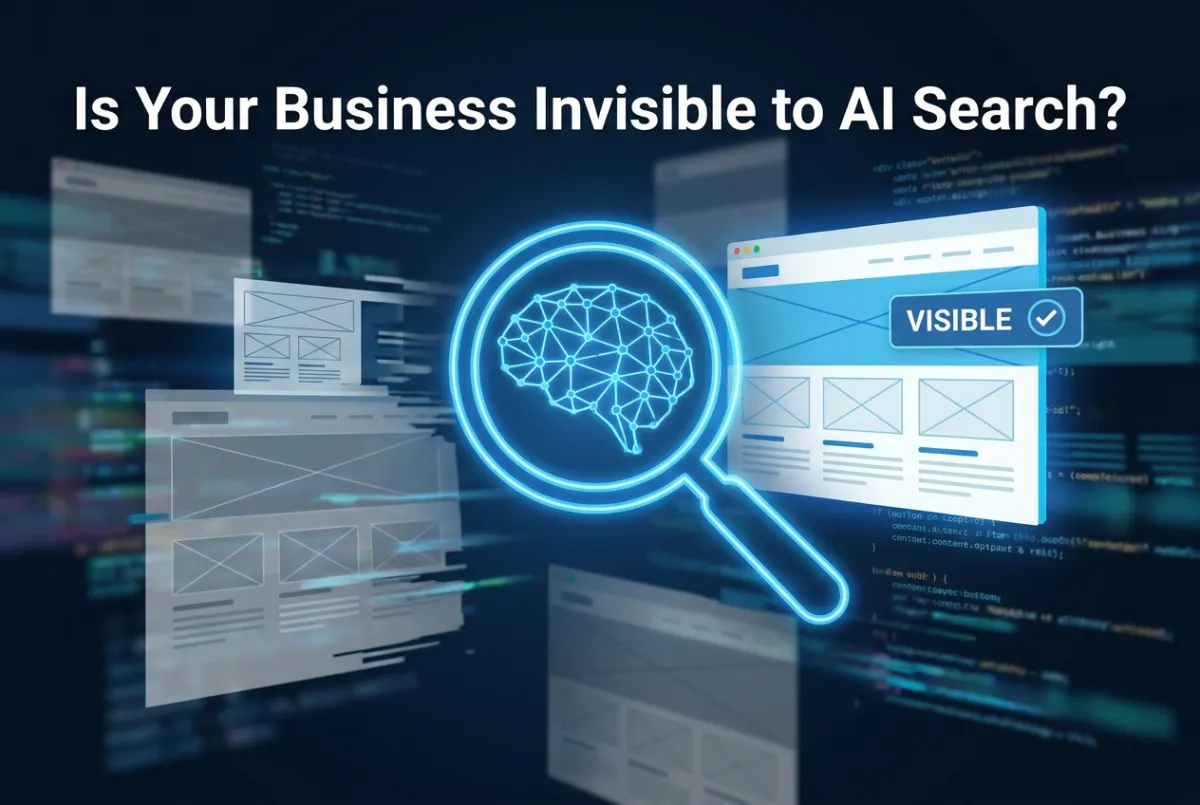
If your website was built or last updated before 2024, it is probably not showing up where a growing number of your potential customers are looking for you.
Not because it is a bad website. Because the way people search has changed faster than most business owners realize, and most websites have not kept up.
This article explains what AEO and GEO are, why they matter for a small service business, and what it actually takes to update a website so it works in the search environment of 2026.
Two Terms Worth Understanding
You may have seen the terms AEO and GEO showing up in conversations about websites and search. Here is what each one actually means.
AEO stands for Answer Engine Optimization. This is the practice of structuring your website so that search engines and AI tools can pull a direct answer from it when someone asks a question. Instead of showing ten links and making the user decide which one to click, an answer engine reads your page and delivers the answer directly. Google's Featured Snippets, voice search results from Siri and Alexa, and Google's AI Overview all work this way. If your page is structured correctly, your business becomes the answer. If it is not, someone else's does.
GEO stands for Generative Engine Optimization. This is newer and more specific. It refers to optimizing your content so that AI platforms like ChatGPT, Perplexity, and Google's AI Mode cite your business when generating a response to a user's question. These platforms do not show a list of links. They produce a complete answer, and they cite a small number of sources to back it up. Getting cited in those answers is the new version of ranking on page one.
AEO and GEO overlap significantly in practice. Both require the same foundational changes to how a website is built and how its content is written. For the rest of this article, we will use AEO as the umbrella term since it is more self-explanatory for most business owners.
Why This Matters Right Now
Most business owners do not realize how fast search behavior has changed.
ChatGPT now has roughly 800 million weekly active users, double what it had eight months earlier. Google AI Overviews now appear on 48% of all tracked search queries as of early 2026, up from about 7% at the start of 2025. AI tools now handle 56% of global search-related sessions. If you are still building your visibility strategy around how people searched in 2022, the map has changed.
For a local service business, this is the number that matters. ChatGPT currently recommends only 1.2% of local businesses when answering service-related queries. That means 98.8% of local businesses are invisible in AI-generated responses, not because AI dislikes them, but because their websites are not structured in a way that AI can read and trust.
The businesses that show up are not necessarily the best ones in their market. They are the ones whose websites speak the language AI search engines understand.
There is also a conversion argument that does not get talked about enough. AI search traffic converts at 14.2% compared to Google's traditional 2.8%. The visitors arriving from AI-generated answers are not browsing. They have already received a recommendation. They are arriving with intent.
What Makes a Website AEO Compatible
A website that is not built for AEO typically has the same problems across the board. The content exists, but it is not structured in a way that an AI can confidently extract and cite. These are the specific things that need to change.
Clear question and answer structure. AI systems are built to answer questions. A website that buries its most useful information inside paragraphs of general copy does not give an AI anything clean to work with. Pages need to be organized around the actual questions customers ask, with direct answers that follow immediately. A section titled "How does your service work?" followed by a clear two to three sentence answer is something an AI can use. A paragraph that wanders toward the same answer is not.
FAQ sections on key pages. Content with FAQPage schema has one of the highest citation rates in AI-generated answers. This is not just about adding a list of questions to the bottom of a page. It is about identifying the specific questions your customers are actually asking, writing direct answers, and marking them up correctly so AI systems know what they are reading.
Schema markup. Schema is background code that tells AI systems and search engines what your content means. Without it, a search engine has to guess whether a number on your page is a price, a phone number, a date, or a rating. Schema removes the guesswork. For a local service business, the most important schema types are LocalBusiness, FAQPage, and Service. Most websites built on standard platforms have little to no schema markup unless someone specifically added it.
Content that answers real questions. AI systems favor content that is authoritative, specific, and written to answer what users actually ask. Generic copy about how your company is committed to quality does not get cited. A page that clearly explains what you do, who you serve, what your service area is, how your pricing works, and what a customer can expect from the process gives AI something concrete to reference.
Technical access for AI crawlers. Every major AI platform has its own crawler. GPTBot crawls for ChatGPT. PerplexityBot crawls for Perplexity. ClaudeBot crawls for Claude. If these crawlers are blocked in a website's robots.txt file or firewall settings, the AI never sees the site at all. Many websites block these crawlers unintentionally because they were set up before these tools existed.
Updated content. Perplexity and similar platforms favor content published or updated within the last six to eighteen months for time-sensitive topics. A website with a blog last updated in 2021 or service pages that have not been touched in three years sends a signal that the content may not be current. Regular updates, even minor ones, improve citation chances.
What Has Not Changed
Traditional SEO is not dead. A website still needs to rank well on Google. It still needs fast load times, mobile responsiveness, good page structure, and relevant content. Those fundamentals have not gone away.
What has changed is that traditional SEO is now a floor, not a ceiling. A website that ranks well on Google but is not structured for AI search is leaving a growing portion of search traffic on the table. In 2026, doing one without the other is an incomplete strategy.
What This Looks Like in Practice
An AEO update is not a full website rebuild. For most small service businesses it involves several specific changes to an existing site.
The content on service pages needs to be restructured around questions. FAQ sections need to be added and marked up correctly. Schema markup needs to be implemented across key pages. AI crawler access needs to be verified and corrected where needed. And the content itself needs to be reviewed to make sure it answers the questions customers are actually searching for rather than reading like marketing copy.
How much work that involves depends on how the current website is built, how many pages need updating, and how much of the content needs to be rewritten versus restructured. That is why we do not publish a flat rate for this service. That conversation starts with looking at what the current site is actually doing and identifying what needs to change.
What LeadX22 Does
At LeadX22, website updates for AEO and GEO compatibility are part of our AI Website Services. We review what the current site is doing, identify the specific gaps in structure, schema, and content, and make the changes that move the needle on AI search visibility.
Pricing is custom because the work is not the same for every site. A business with ten service pages, no schema, and content that was written in 2019 requires different work than a business with a recently updated site that just needs schema implementation and FAQ restructuring.
If you want to know where your site stands, that starts with a review.
What's Your Next Step?
Ready to Talk
Want to find out where your website stands in AI search and what it would take to update it? Book a call and we will walk through it.
Still Researching
Continue learning how AI, automation, reputation management, and lead follow-up can improve business performance.
Stay Informed
Get notified when new articles, guides, and business AI insights are published.

© 2026 LeadX22 | All Rights Reserved
Facebook
Instagram
LinkedIn
Youtube