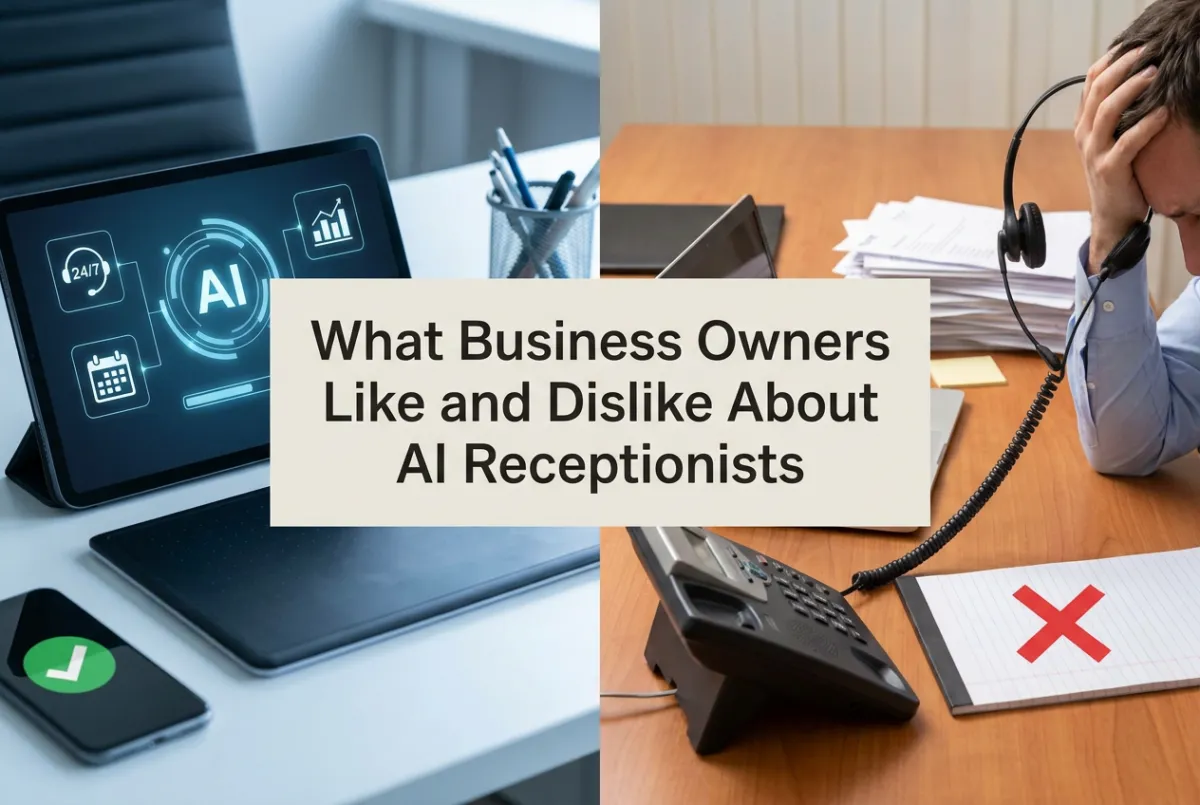
What Business Owners Like and Dislike About AI Receptionists
If you are considering an AI receptionist for your business, the best research you can do is talk to people who already have one running. Not the sales page. Not the demo. The people actually using it six months in.
This article is based on that feedback, compiled from business owner interviews, public platform reviews, and documented case studies from 2025 and 2026. The likes and dislikes are both real. We did not go looking for the good reviews and ignore the rest.
What Business Owners Like
They stop missing calls, including the ones they did not know they were missing.
This is the most common thing owners mention first. They knew they were missing some after-hours calls. They did not know how many until the AI started logging them. An HVAC company in Phoenix that switched in July 2025 reported handling 40% more calls within nine months. The calls were always coming in. They just had nowhere to go before.
For home service businesses like HVAC, plumbing, roofing, and electrical, this is where the ROI shows up fastest. A caller with a broken AC at 11 p.m. is not going to wait until morning. If your AI answers and books a service window, that job is yours. If it goes to voicemail, it goes to whoever picks up next.
The phone stops running their day.
Business owners who handle their own calls describe the same pattern: constant interruptions, calls during jobs, calls during estimates, calls during family time. Once an AI handles the routine volume, the owner's phone becomes something they check rather than something that runs them. Several owners specifically mention being able to stay focused on billable work without the phone pulling them out of it every twenty minutes.
Appointments get booked without a back-and-forth.
A caller who wants a time slot gets one in real time, without waiting for a callback that may or may not happen within their attention window. For any business where scheduling is the primary action a caller wants to take, this is a significant operational improvement. 78% of customers go with the first business that responds. An AI that books the appointment while the caller is still on the line is going to close that job more often than not.
The consistency surprises them.
A human receptionist has good days and bad days. They get busy, distracted, or burned out. A well-configured AI gives the same answer in the same tone on the thousandth call as on the first. For businesses that field a lot of the same questions about service area, hours, pricing ranges, and what to expect. That consistency is something owners notice once they have it and do not want to give up.
Call data they never had before.
AI receptionists generate logs of every call: volume by day and hour, question types, how calls end, where callers drop off. Most business owners have never had visibility into this before. Owners report using the data to identify patterns they had no idea existed. Peak call times, frequently asked questions that were never in their FAQ, callers who called multiple times without getting booked.
The cost compared to alternatives.
Once owners do the actual math on what a full-time receptionist costs, including salary, taxes, benefits, PTO, and turnover. The monthly AI cost looks very different. Several owners say running the real number was what finally made the decision obvious.
What Business Owners Dislike
It struggles with questions it was not trained to answer.
This is the most documented failure point. A dental practice owner switched to an AI receptionist in early 2025 to cut costs. Within two months, appointment booking rates dropped from 65% to 42%. The problem was straightforward: patients were asking questions the AI could not answer. Insurance coverage, out-of-pocket costs for specific procedures, same-day emergency availability. The AI defaulted to "let me have someone call you back" and roughly half those callers never waited.
The AI is only as good as what it knows. If it has not been trained on the specifics of the business, it gives generic answers or deflects. Generic answers lose calls. This is a setup problem, not a technology problem, but owners who do not understand that going in find out the hard way.
Loops and dead ends when something goes off-script.
The second most common complaint, and in some cases the most costly. A caller has a situation the AI was not built to handle. Instead of routing to a person, it cycles through options the caller has already declined. One bad loop and that caller is gone. This is a configuration problem. Every AI setup needs clear handoff triggers for calls that need a human, but owners who bought a cheap platform and left it on default settings hit this regularly.
The initial setup takes more time than expected.
Owners who went the self-serve route consistently report underestimating setup time. Writing the call scripts, training the AI on business specifics, connecting it to the calendar and CRM, testing it before going live. That process takes longer than the sales pitch implies. Several owners describe going live too soon and having callers encounter an AI that was not ready. The ones who took the time to configure properly before launch had significantly better outcomes.
It does not handle emotional calls well.
Upset customers, complex complaints, sensitive situations. The AI cannot read tone the way a person can, and it cannot adjust in real time to an emotional caller the way a skilled human can. Owners in industries where friction calls are common, billing disputes, warranty issues, service complaints, find the AI falls short in these situations and sometimes makes things worse by giving a scripted response when a caller needs a person. The consistent feedback is that these calls need a human, and the AI needs to know when to hand off rather than attempt to resolve them.
Some callers just do not want to talk to an AI.
This one varies significantly by industry and customer base, and it is a mistake we made ourselves early on.
We deployed an AI receptionist for a mobile RV repair company in Southwest Florida. The service itself was a good fit. Mobile repair, inbound calls, appointment scheduling. All the right ingredients were there. What we failed to do before launch was take a hard look at who was actually calling. The customer base was largely older, retired RV owners. Several of them pushed back on the AI immediately. They did not want to talk to it. Some hung up. Some called back frustrated.
The technology was not the problem. The customer profile was. That experience is now part of how we approach every new deployment. We now make it a point to understand who is on the other end of the call before anything goes live. An AI receptionist that is right for one business can be the wrong call for another, and the difference is not always about the service. Sometimes it is about who the customers are.
Billing surprises on the wrong plan.
Owners who chose budget platforms with per-minute or per-call billing describe unexpected invoice spikes during busy periods. A seasonal business that gets hit with a call surge, a roofing company during storm season or an HVAC company during a heat wave, can see their AI costs multiply in a month where they can least afford surprises. The consistent recommendation from owners who hit this is to choose flat-rate plans before you need them, not after.
What the Pattern Tells You
Reading through the feedback across dozens of business owners, a pattern shows up clearly on both sides.
The owners who like their AI receptionist most are the ones who set it up properly, trained it on the specifics of their business, built in clear handoff paths for calls that need a human, and chose a flat-rate plan that does not penalize them for volume.
The owners who dislike it most bought on price, skipped setup, went live before the AI was ready, and got surprised when it could not handle situations it was never trained for.
The tool is not what determines the outcome. How it gets set up is.
A Note on Where We Stand
At LeadX22, we configure AI receptionists for service businesses. We are telling you the dislikes above because a client who goes live with an AI that is not ready costs us more than it costs them — in time, in fixes, and in trust. The setup fee on our DFY plan exists specifically to make sure the AI is trained, tested, and ready before any caller ever hears it.
If you are evaluating whether an AI receptionist is the right fit for your business, the Revenue Leak Review is where that conversation starts, before any tool gets recommended.
What’s Your Next Step?
Ready to Talk
Want to find out where leads, calls, and opportunities may be slipping through the cracks? Schedule a Revenue Leak Consultation.
Still Researching
Continue learning how AI, automation, reputation management, and lead follow-up can improve business performance.
Stay Informed
Get notified when new articles, guides, and business AI insights are published.
