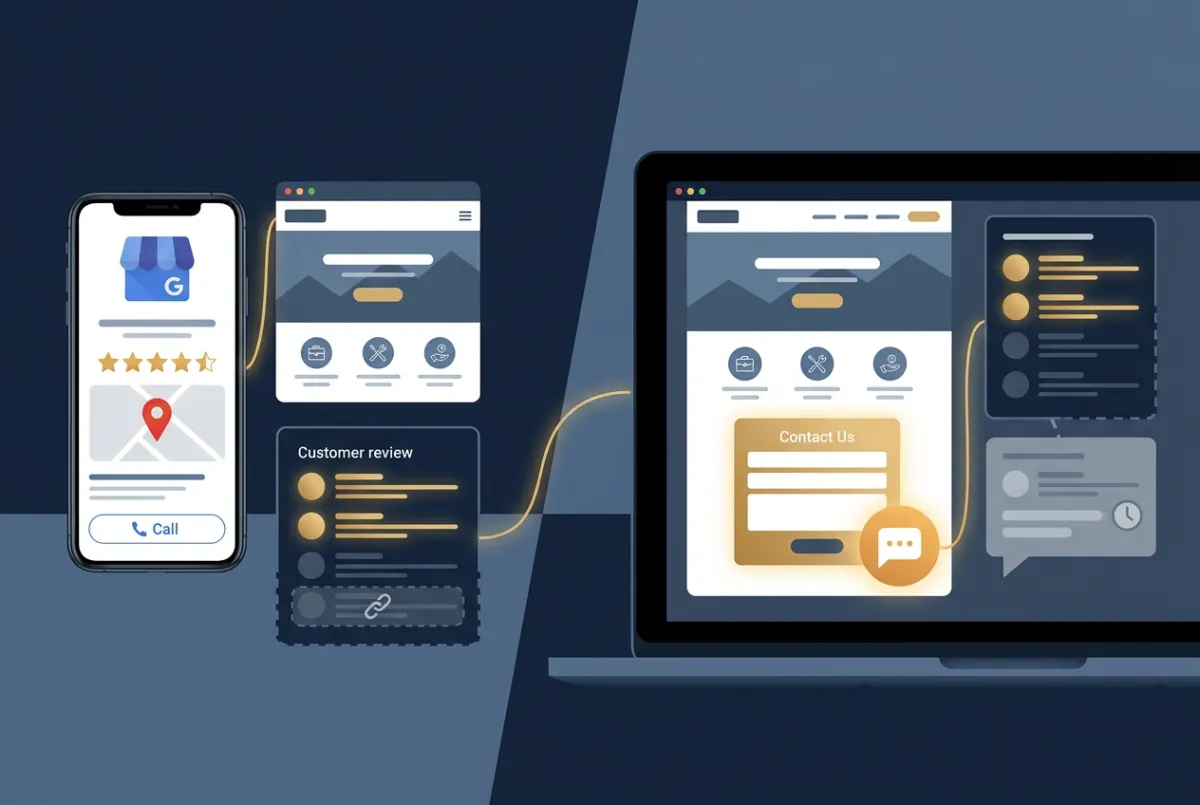
Your Online Business Infrastructure Is Either Making You Money or Costing You Leads
Most business owners never think about their business that way. They don't sit down and audit their "online infrastructure." But they know the symptoms. If you run a service business, one or two of these probably sound familiar:
"I built my website years ago and haven't touched it since."
"My site looks like every other contractor in town."
"I don't actually know if it works well on a phone."
"Someone set up my website, my Google listing, and my forms, and I honestly don't know how they connect."
"I know I should be asking for reviews. I don't have a system for it."
"My hours, services, or service areas don't match across Google, Facebook, Yelp, and my website."
"Leads come through the site. I'm not sure who follows up, or how fast."
"People call after hours. I don't know how many of those we lose."
None of these are small problems. Each one is a place where a potential customer either finds you or doesn't, trusts you or doesn't, and reaches you or doesn't. That's what your online infrastructure means here. It's not servers, complicated software, or some technical thing only big companies worry about. It's the full set of things standing between a homeowner searching for help and you actually getting the job.
What's Actually in Your Online Infrastructure
Break it down and it falls into a few categories.
Can they find you?
This is your Google Business Profile, your directory listings (Yelp, Apple Maps, industry-specific sites), and whether your business name, address, and phone number match everywhere. It's also whether your website has real pages for the services and areas you actually serve, instead of one homepage trying to cover everything.
Do they trust what they find?
Reviews, and not just how many you have. Do you respond to them? Are they recent? Do they mention the services you actually want more of? Is there proof beyond your own website, testimonials, licenses, associations, before-and-after photos, that you're legitimate and good at what you do? For a lot of service businesses, these signals are missing, outdated, or scattered across too many places to hold together. That creates hesitation, and hesitation costs leads.
Does anything happen when they reach out?
This is the one that quietly costs the most money. Someone fills out a form, calls after hours, or leaves a voicemail. What happens next? Is there a system for it, or does it depend on whoever happens to check their phone that day? How fast does someone actually follow up, and what happens if that first callback doesn't land? A lead doesn't have to disappear loudly to cost you money. Sometimes it just sits too long.
Can AI tools find and recommend you?
This one's newer, and it's the one most local businesses haven't thought about at all. Homeowners are starting to ask ChatGPT, Google AI, and similar tools who they should hire, the same way they used to just Google it. They might ask "who's the best roofer near me," "what HVAC company has strong reviews in my area," or "who builds screened porches in my city." AI tools pull from clear, consistent public information to answer those questions. If your website is thin, your Google profile is outdated, your listings don't match, or your reviews are weak, those tools may not understand your business well enough to recommend it. You could be the best option in your market and still never come up.
Why This Matters More Every Month
This isn't a reason to panic. It's a reason to find out where you actually stand.
Search is changing faster than most owners realize. BrightLocal's 2026 consumer research found that the share of people using AI tools to find local business recommendations jumped from 6% to 45% in a single year, third behind only Google and Facebook. Separate research from SOCi, analyzing more than 350,000 business locations across multi-location brands, found that ChatGPT recommended just 1.2% of measured locations. The point is clear: showing up in Google does not automatically mean a business is showing up when customers ask AI tools for recommendations.
That gap is exactly what most local businesses haven't checked yet.
What We Do About It
This is exactly why I built the $149 Website and AI Visibility Review. I go through the key parts of your online infrastructure and look at where you show up, what people find when they do, and what happens in the minutes after someone tries to reach you. You get a written report, a fix list ranked by what's actually costing you the most, not a generic checklist, and a walkthrough of every finding.
If we end up doing any of the work together afterward, the $149 goes toward it.
If any of the lines above sounded familiar, it's worth taking a closer look. Head to leadx22.com to request your Website and AI Visibility Review, or reach out directly and I'll walk you through it.
What's Your Next Step?
Want a straight look at your website? If your site looks professional but doesn't seem to be producing calls, we'll go through it and tell you what's clear, what's missing, and what would actually be worth fixing first. You'll see how your business comes across to customers and to the systems now recommending businesses. $149 flat fee, no pressure, no obligation to do more. Request Your Website & AI Visibility Review
Rather just talk it through? Schedule a conversation and we'll walk your website and your online presence together. Bring the questions you've been putting off. Schedule a Conversation
Still researching? Keep reading about local visibility, reviews, customer trust, and what makes a website earn its keep. Or subscribe and we'll send new articles as they're published. No pitches, just useful information. Read More Articles
About the Author
John Collins is a revenue leak diagnostician and founder of LeadX22, an AI readiness advisor for service businesses. With a background spanning air traffic control, operations, and business ownership, John helps local companies identify where leads and revenue are slipping away and prescribe the right mix of process, automation, and AI to fix it. He focuses on diagnosis first, not tools first. Learn more at https://leadx22.com.
