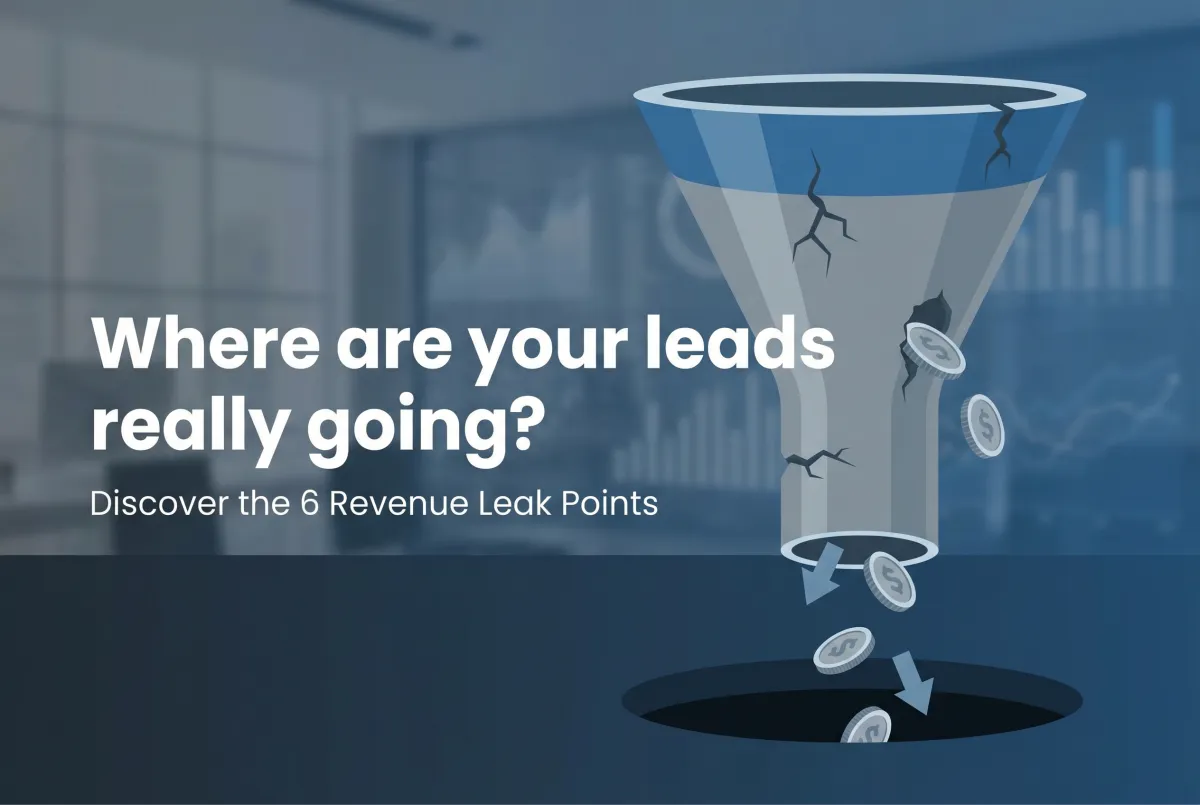
6 Places Your Business Is Bleeding Revenue After the Lead Comes In
A business owner called me frustrated. He was spending $5,000 a month on Google Ads and "the leads weren't converting."
I asked one question: "What percentage of your inbound calls do you actually answer?"
Silence.
"I don't know."
That's the problem. Most business owners think they need more leads. What they actually need is to stop losing the ones they already have.
You Don't Have a Lead Generation Problem
Here's what I see over and over: business owners pour money into marketing—Google Ads, Facebook campaigns, SEO, referral programs—and then watch leads disappear after they come in.
Not because the leads were bad. Because the business wasn't set up to capture them.
Calls go to voicemail. Voicemails sit for hours. After-hours inquiries vanish into a black hole. Follow-up lives in someone's head instead of a system. And nobody can tell you where a lead is in the pipeline because there is no pipeline—just chaos held together by memory and hope.
You can't fix a leak you can't see. And most business owners have no idea how much revenue is slipping through after the lead comes in.
The Six Revenue Leak Points
I worked with a custom home builder recently who thought his problem was lead quality. Turned out his problem was lead handling. Before we fixed anything, calls after 5 PM went straight to voicemail. Weekend inquiries sat until Monday morning. By the time someone called back, the lead had already talked to three competitors.
We put an IVR system in place—nothing fancy, just a way to capture calls when the office was closed and route them properly when it was open. Within 30 days, he stopped losing after-hours leads to competitors who were faster.
That's one leak. Here are the other five.
1. Call Answer Rate: The Leads You Never Knew You Lost
Most businesses have no idea what percentage of inbound calls actually get answered by a human. Calls go to voicemail when the line is busy, when the receptionist is helping someone else, when everyone's in a meeting, or when the office is closed.
And 85% of people won't leave a voicemail. They'll call the next business on the list.
If you're not answering calls, you're not getting leads. It's that simple. But you can't fix it if you don't know it's happening.
Diagnostic Question: What percentage of your inbound calls get picked up by a human instead of going to voicemail?
2. Response Time: The 5-Minute Window You're Missing
An MIT study found that the odds of contacting a lead drop 100 times if you wait 30 minutes instead of responding in 5 minutes. Not 100%. One hundred times.
Most businesses think same-day callback is good enough. It's not. By the time you return the voicemail four hours later, the lead has already talked to someone who called back in ten minutes.
Speed matters. And if your response time is measured in hours instead of minutes, you're losing deals before you even know they existed.
Diagnostic Question: How long does it take you to return a voicemail or respond to a web form lead?
3. After-Hours Lead Capture: The Weekends and Evenings You're Closed
What happens when a lead calls at 7 PM on a Saturday? For most businesses, it goes to voicemail. And by Monday morning when you call back, they've already booked with someone who was available when they needed help.
You don't have to work weekends. But you do need a way to capture after-hours leads so they don't disappear to competitors who do.
That's what we fixed for the home builder. An IVR system that answered calls, captured information, and routed inquiries properly. He didn't have to hire weekend staff. He just stopped bleeding leads during the 60% of the week his office was closed.
Diagnostic Question: What happens to a lead who contacts you at 7 PM on a Saturday?
4. Lead Qualification Process: The Time You Waste on Bad Fits
Not every lead is worth your time. Some are price shopping. Some are tire kickers. Some are outside your service area or looking for something you don't offer.
If you're spending time on unqualified leads, you're not spending time on real buyers. And if you don't have a qualification process—a script, a set of questions, a way to filter early—you're wasting hours every week on conversations that were never going to close.
Diagnostic Question: Do you have a process to qualify leads upfront, or do you spend time on everyone who calls?
5. Follow-Up System: The Leads That Say "Not Right Now"
Most deals don't happen on first contact. The lead says "call me back in three months" or "we're not ready yet" or "let me think about it."
And then what? For most businesses, that lead disappears. It lives in someone's mental notes. Maybe they remember to follow up. Probably they don't.
Meanwhile, the lead moves on. They find someone else. Or they forget you existed. And three months later when they're ready to buy, you're not even in the conversation.
If your follow-up system is "I'll remember to call them back," you don't have a system. You have hope.
Diagnostic Question: What happens to a lead who says "not right now"—is there a system to nurture them, or do they just disappear?
6. Pipeline Visibility: The Leads Falling Through the Cracks
Can you tell me right now where every lead is in your pipeline? Not just the hot ones you're working. Every single one.
If the answer is no, you have a visibility problem. Leads are scattered across sticky notes, spreadsheets, text messages, and someone's memory. And when leads live in chaos, they fall through the cracks.
You can't fix what you can't see. And if you can't see your pipeline, you can't fix the leaks.
Diagnostic Question: Can you see every lead, where they are in the process, and what the next step is—or is it scattered across multiple places?
What This Actually Costs You
These aren't small inefficiencies. They're revenue walking out the door every single day.
A missed call is a lost deal. A slow callback is a competitor's win. An after-hours lead with no capture system is money you'll never see. A lead that says "not now" with no follow-up is a customer you'll never close.
Add it up. If you're losing 20% of inbound calls to voicemail, responding in hours instead of minutes, missing every after-hours inquiry, and letting warm leads go cold because follow-up lives in someone's head—you're not losing 20% of potential revenue.
You're losing 50%. Maybe more.
And the worst part? You probably don't even know it's happening.
Stop the Bleeding
You don't need more leads. You need to stop losing the ones you already have.
Most business owners can't answer the six diagnostic questions above. They don't know their call answer rate. They don't track response time. They don't have an after-hours system. They don't qualify leads upfront. They don't have a follow-up process. And they can't see their pipeline.
That's not a strategy. That's a leak.
Not Sure Where Your Revenue Is Leaking?
Book a free 30-minute Revenue Leak Analysis. We'll walk through these six areas, show you exactly where leads are slipping through, and tell you what it's costing you.
No pitch. No pressure. Just a clear diagnostic of where your revenue is going—and how to plug it.
Book your Revenue Leak Analysis here: Schedule Now
About John Collins
John Collins builds operational systems for service businesses that are successful but fragile. He specializes in preventing revenue leaks, reducing owner dependency, and keeping businesses running smoothly when key people leave. Learn more at LeadX22.com.
